Patrick Faison, Microsoft 365 Architect
FABCON 2026 marked a pivotal moment for Microsoft Fabric—not because of a single feature announcement, but because of a clear shift in how end users, data teams, and business leaders are expected to interact with data going forward. This year’s conference made one thing unambiguous: Fabric is no longer just a unified analytics platform. It’s evolving into an intelligent, AI‑native system designed to actively participate in decision‑making across the organization.
From the keynote to the breakout sessions, the conversation consistently returned to one central theme: simplifying the end‑user experience while increasing the intelligence of the platform itself.
The End‑User Experience: A Week of Insight, Exchange, and Collaboration
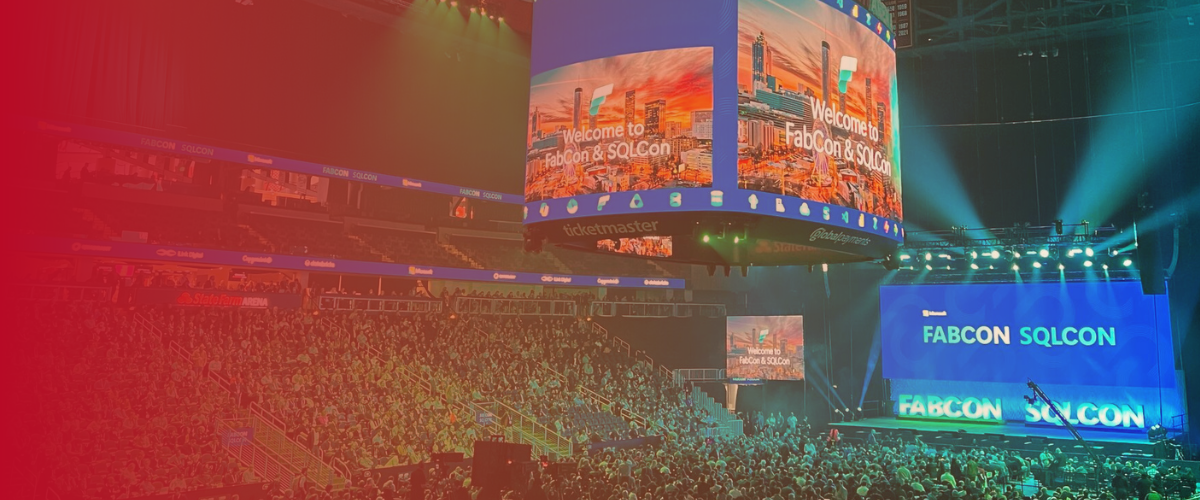
FABCON 2026 returned for its third year, marking my initial experience attending this notable event. SQLCON also joined the event, bringing both communities together with over 8,000 attendees. During my time there, I had the opportunity to meet a lot of professionals and hear about their shared experiences leveraging Fabric in their day-to-day operations.
During the solution showcase, we were able to connect, explore, and have hands-on conversations with the Microsoft Experts and Partners, maximizing our time with tangible insights. Attendees were also tested on their Fabric and SQL knowledge through hands-on challenges, reinforcing the ability to gain insightful information during the event.
At the center of FABCON 2026, there was a powerful sense of community where professionals were able to connect, mentor, and engage in thoughtful dialogue that solidified perspectives across many roles and experience levels. This moment made everything clear for me: Fabric and SQL ecosystems are thriving, evolving, and gaining unstoppable momentum.
Microsoft Fabric: Less Friction, More Intelligence
A standout theme was how Microsoft’s new focus on the data consumption experience prioritizes action and outcomes over simple storage or visualization. Instead of concentrating on dashboards as the destination, Fabric is evolving toward systems that interpret data on the user’s behalf and surface insights proactively.
AI features such as Copilot, Fabric IQ, and data agents are no longer framed as optional; they are foundational to how business users engage with Fabric. Increasingly, end users interact through natural language, guided workflows, and AI driven recommendations rather than navigating complex pipelines, schemas, or reports. This represents a clear evolution from traditional self service business intelligence (BI) to assisted decision intelligence, where intent, context, and reasoning are as critical as the metrics themselves.
For business stakeholders, this reduces time‑to‑insight. For technical teams, it reinforces the importance of strong semantic models, governance, and data quality, because AI is only as effective as the data foundation beneath it.
Key Announcements at FABCON 2026: Fabric Becomes an Intelligence Layer
Rather than a long list of disconnected features, FABCON 2026 announcements told a cohesive story about Fabric as a unified intelligence platform. Here are the highlights:
Fabric IQ and Data Agents
Fabric IQ emerged as a central pillar, providing context and reasoning on top of data stored in OneLake. Combined with Fabric data agents—now generally available—Fabric can act as a virtual analyst, monitoring trends, answering domain‑specific questions, and surfacing insights without manual prompting.
These agents are intrinsically connected to semantic models, lake houses, and warehouses, reinforcing that metadata and governance are no longer “nice‑to‑haves,” but prerequisites for AI effectiveness.
Database Hub
Another major announcement was the Database Hub, which introduces a centralized control plane for managing diverse database environments—from Azure SQL and Cosmos DB to SQL Server via Azure Arc—directly within Fabric. This blurs the line between transactional and analytical workloads and positions Fabric as a holistic data estate management platform rather than a downstream analytics layer.
Major Updates at FABCON 2026: OneLake, Governance, and Real‑Time Data
OneLake Security (GA)
OneLake security reached general availability, introducing a single, consistent access control model enforced across Spark, SQL, and Power BI. This “secure once, enforce everywhere” approach significantly reduces operational complexity and strengthens compliance posture for enterprises.
Mirroring and Zero‑Copy Architectures
Expanded mirroring support (SAP, Oracle, and other enterprise systems) and shortcut transformations continue to push Fabric toward a zero‑copy, near real‑time data architecture. This enables faster analytics with less data movement and positions OneLake as the logical home for enterprise data, regardless of where it physically resides.
Real‑Time Intelligence and Graph
Graph capabilities and real‑time intelligence features became generally available, allowing organizations to model relationships and event‑driven scenarios directly within Fabric. These updates support advanced use cases such as fraud detection, supply chain insights, and AI reasoning over connected data sets.
Closing Thoughts
FABCON 2026 was a celebration of the remarkable momentum behind the global data community. Throughout the week, thousands of attendees gathered to learn, connect, and explore how Fabric and SQL technologies are shaping the future of data and AI. For me, it was less about individual feature announcements and more about a clear signal of a mature, unified vision. Microsoft Fabric is emerging as the connective tissue between data, AI, and decision‑making, streamlining end‑user experience while dramatically expanding what the platform can do on behalf of the business.
For organizations investing in Fabric today, the message is clear: focus on fundamentals like governance, semantics, and architecture because those choices will directly determine how much value AI and agentic capabilities can deliver tomorrow.
Turn Fabric Insights Into Action
Let’s talk
MicroAge can help you align Microsoft Fabric with your data strategy, strengthen governance, and unlock AI-driven insights across your organization. Contact your MicroAge representative or call us at (800) 544-8877 to get started.
“As MicroAge’s Microsoft 365 Architect, Patrick designs and implements modern workplace solutions that help organizations collaborate securely and efficiently. He partners with clients to maximize the value of their Microsoft 365 investments through strategic planning and expert guidance.”
Patrick FaisonMicrosoft 365 Architect