



By Avery Schaller, Senior Presales Engineer
Whether you are evaluating AWS for the first time, or you created an account years ago, gave AWS your credit card, and never looked back, the way your organization procures cloud services matters more than most people realize. The path you choose can create downstream consequences that many teams do not think about until they are already feeling the impact. How you buy AWS, how you manage it, and who advises you along the way can dramatically affect your costs, security posture, and ability to move quickly as your business grows.
The Flexera 2026 State of the Cloud Report found that 85% of cloud decision-makers say managing cloud spend is their number one challenge. That same report called out wasted cloud spend at 29% across the board. At the scale the industry operates at today (global cloud infrastructure spending hit a $500 billion annual run rate this year, according to Synergy Research Group), that is not an insignificant amount of money going to resources that potentially deliver zero business value.
This is not just a cost problem. Security gaps, support overhead, missed cost optimization opportunities, and now AI infrastructure decisions are all part of the same equation. The question is not whether AWS is the right platform, because for many organizations, it is. When implementing and managing cloud infrastructure, it’s important to determine if going direct with AWS is the right model, or whether a partner would get you to better outcomes faster, and for less. Developing the right AWS strategy requires evaluating much more than infrastructure alone.
It is worth remembering the dynamic at play here. AWS builds and sells cloud infrastructure. Their business grows when your consumption grows. That is not a criticism; it is simply how the model works. However, partners should be measured by your outcomes, and good partners should inherently be looking for ways to make sure your cloud environment is well-architected and cost-optimized. When organizations go direct, they don’t inherently have an independent advisor proactively challenging overprovisioning or inefficient design choices.
So, whether you are building a new AWS environment, reassessing how you manage your current footprint, or deciding whether a partner should be part of the equation, here are six things worth considering.
1. Advice Should Start Before the First Resource Gets Deployed
Opening an AWS account takes maybe ten minutes. Deploying an EC2 instance and stuffing an on-prem VM into it might not take much longer, at least in the “technically it runs” sense. But technically running in AWS is not the same thing as being well-architected, cost-effective, secure, or easy to operate.
Moving to the cloud is not always just a matter of relocating infrastructure. It introduces some important nuances, particularly around how and when to choose between infrastructure and platform services, as well as how scalability and resiliency are incorporated into the design. These decisions are not always obvious upfront, but they can shape cost, performance, and security outcomes for years.
A good partner should be asking relevant questions before a single resource goes live. What business outcome are you trying to achieve? Is your envisioned design optimized with the way AWS pricing actually works? Does the vibe-coded app your CFO cooked up over the weekend contain a bunch of exposed API keys and plain text passwords? Should this workload be in the cloud at all? While those questions cost nothing to ask, skipping them can get very expensive, very fast. A thoughtful AWS strategy helps organizations avoid these costly missteps from the beginning.
2. AWS Support Costs Add Up Faster Than Most Teams Expect
If you are running production workloads in the cloud, I highly recommend that you have at least the Business Support+ plan, and larger organizations with significant AWS workloads should consider Enterprise Support. For those who are unaware, AWS Basic Support is essentially self-service and doesn’t allow you to open technical support tickets. Finding out there are no experts to ask for help when prod is down on a Friday afternoon is an intensely unpleasant experience, and something I recommend you avoid experiencing firsthand.
However, those AWS direct support plans are almost always priced as a percentage of your cumulative AWS charges. For example, AWS Enterprise Support is priced as the greater of two numbers: either $5,000 per month or a tiered percentage of your AWS spend: 10% of the first $150,000 in monthly charges, 7% of the next $350,000, 5% of the next $500,000, and 3% thereafter. Consequently, an organization spending $500,000 per month on AWS would expect support costs that can run close to $40,000 per month.
Alternatively, Partner-led support for AWS offers comparable (or better) SLAs, technical depth, and escalation paths to AWS Enterprise support, at a significantly lower price point.
4. Cost Optimization and Security Are Not Separate Conversations
Cloud spend, security posture, reliability, and operational efficiency are often discussed as separate initiatives. However, in practice, they are inescapably intertwined.
The Well-Architected Framework is useful here because it aligns with industry best practices and provides a structured framework for evaluating architectural decisions. It is not just a cost optimization exercise. It is a broader review of how the environment is designed, operated, and improved over time.
As a practical example: tightening identity and access management (a security move) often reveals over-provisioned resources (a cost move). Right-sizing instances to reduce spend forces a conversation about whether workloads are deployed in the most resilient configuration. These things are connected, and reviewing them together produces better results than chasing them one at a time. Integrating these considerations into your AWS strategy leads to stronger long-term outcomes than addressing them independently.
4. Private Pricing Agreements Can Save Real Money, or Cost You If You Get Them Wrong
If your organization spends north of $500,000 a year on AWS, a good partner should be bringing up Private Pricing Agreements (PPAs). A PPA is a spending commitment with AWS over one, two, or three years in exchange for a discount on your overall consumption.
This is especially valuable when leveraging the AWS Marketplace for 3rd-party software purchases (such as CrowdStrike, Mimecast, or Anthropic), since PPAs allow up to 25% of your commitment to be met through eligible AWS Marketplace purchases.
While that value is real, it is important to remember there is a real risk with a PPA. Commit to a million dollars annually and come in at $900,000? AWS will charge you the $100,000 difference. This is why cost optimization needs to happen before you enter a PPA, not after.
Structuring this correctly takes experience. Look for a partner who has negotiated dozens of PPAs, understands the pitfalls, and can help you decide on a commitment level that delivers real savings without overexposing your organization.
5. Root Account Access Is No Longer a Barrier
This has historically been one of the biggest blockers when organizations were considering whether working through a partner was right for them. Not too long ago, associating your AWS accounts with a partner through the Channel Transfer Agreement (CTA) process typically required giving that partner root access to your account. Many organizations justifiably hated that requirement with the fury of a thousand suns.
Fortunately, AWS has addressed this with the newer billing transfer process, which handles partner association through billing-level connections rather than root credential access. Your security settings stay intact, and your partner never touches root credentials. It also reduces lock-in concerns, since you retain control of your AWS organization and can switch partners or go back to direct billing with AWS through the applicable association process. This change removed one of the biggest barriers for organizations that wanted the benefits of a partner relationship but could not get past the security implications of the old model.
6. AI Infrastructure Decisions Are Often Cloud Decisions
If AI enablement is on your company’s roadmap (and according to basically every C-suite I talk to these days, it is), then your AWS strategy and AI strategy should probably be handled in the same evaluation process.
That is because AI workloads can change the nature of a cloud conversation very quickly. Suddenly, you are not just talking about virtual machines, storage, and networking. You are talking about GPU availability, model selection, data governance, cost controls that somehow need their own cost controls, and whether the right platform is AWS, Azure, or some combination of both.
This is where a partner can be especially valuable. A good partner should help you evaluate AI infrastructure based on availability, cost, governance, security, and business fit. They should also help you avoid recreating the same cost, security, and governance mistakes that already cause problems in traditional cloud environments, only this time with more expensive infrastructure and a lot less room for trial and error.
What This Means for Your AWS Strategy
To be clear, going direct to AWS is not the wrong decision for every company. But treating it as a set-it-and-forget-it decision is. Support costs, security posture, cost governance, pricing agreements, and the rapidly evolving AI landscape all factor into whether you are getting full value from your cloud investment or leaving both money and operational value on the table.
If you are running in AWS today and want a clear-eyed AWS strategy assessment of where you stand, we offer Well-Architected Framework reviews and cost optimization assessments that give you a practical picture of what is working, what is not, and what to prioritize next.
Learn more at microage.com/aws.
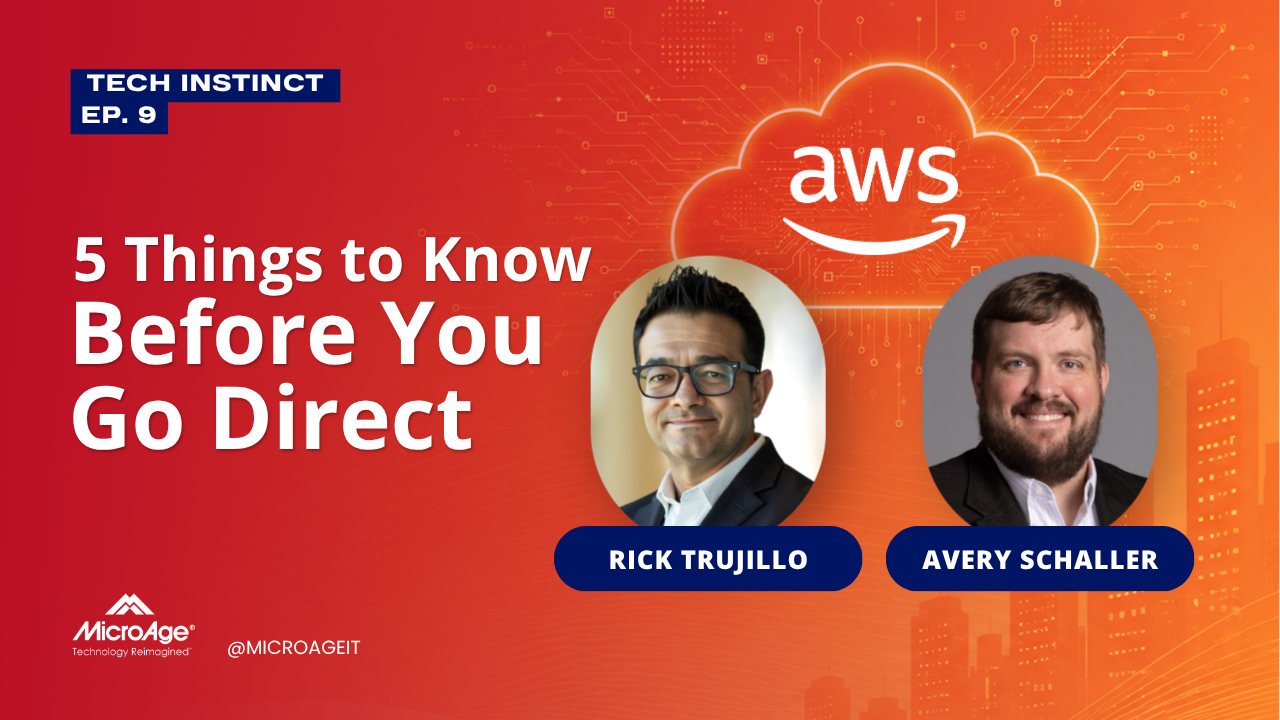
“Avery Schaller is a Senior Presales Engineer at MicroAge, where he advises mid-market and enterprise organizations on cloud strategy across AWS, Microsoft 365 and Azure. He works with IT leaders to optimize cost, strengthen security, and build cloud environments that match how their business actually operates.”
R. Avery SchallerSenior Presales Engineer
Sources:
- Flexera 2026 State of the Cloud Report (flexera.com/blog/finops/flexera-2026-state-of-the-cloud-report-the-convergence-of-cloud-and-value/)
- Synergy Research Group, Q1 2026 Cloud Market Data (srgresearch.com/articles/cloud-market-annual-revenue-run-rate-topped-half-a-trillion-dollars-in-q1-as-growth-surge-continues)
- AWS Support Plan Pricing (aws.amazon.com/premiumsupport/pricing)
- FinOps Foundation 2025 Annual Report / Gartner Q1 2026: AI-related cloud spending at 19% of total cloud spend